
Advancing Progress Toward Our Goals
The following sections detail key initiatives and progress for each of the six core components of our sustainability strategy. Through these efforts, we continue to prioritize measures that embrace sustainable innovation to help reduce emissions and minimize environmental impacts throughout our operations, while providing a positive business benefit.
Fleet Evolution
Improving fleet-wide fuel efficiency through ongoing renewal and working to reimagine What We Fly in a net-zero world
Efficient Aircraft Operations
Continually improving What and How We Fly to maximize the efficiency of our existing fleet and operations
Cleaner fuel
Addressing barriers to increase the availability and affordability of SAF
Ground Operations and Facilities
Reducing impacts of GSE, facilities and other operations
The Travel Experience
Reducing waste and delivering more sustainable products and amenities to our customers
Supply chain
Understanding and reducing climate impacts associated with the goods and services we purchase to run our business
Fleet Evolution
Addressing our carbon footprint starts with What We Fly. In the near term, Delta continues our fleet renewal program by investing in state-of-the-art aircraft that provide safe, reliable and premium customer experiences while delivering superior fuel efficiency and emissions reductions. We are also actively looking toward the future, pursuing partnerships and investments to support revolutionary technologies such as new airframe designs, electric propulsion and more.
Signed our fourth and fifth partnerships with revolutionary tech partners JetZero and Maeve.
Took delivery of 38 next-generation aircraft designed to reduce fuel usage and improve fuel efficiency.
At a Glance Fleet Evolution
OUR TARGETS
2025: 10+% fuel-efficiency gains1 and five partnerships with revolutionary tech players
2035: 20+% fuel-efficiency gains1 and first operation of mainline revolutionary technology
2050: 40+% fuel-efficiency gains1 and 25% revolutionary aircraft2 in fleet
OUR PROGRESS
- Achieved our target of signing partnerships with five companies developing revolutionary fleet technology, rounding out our portfolio across short-, medium- and long-haul markets and multiple propulsion technologies.
- Improved fleet-wide fuel efficiency by 6.4%,1 delivering significant savings in fuel costs.
FLEET RENEWAL
Sustainability is one of the core pillars guiding our fleet strategy and associated decisions concerning capital allocation.
As of 2025, we have achieved a fleet-wide fuel efficiency improvement of 6.4%, falling short of our 10% target.1 Industry-wide supply chain constraints have delayed aircraft delivery and thus our achievement of this milestone. Despite the delay, we remain committed to investing in our fleet and confident in our long-term trajectory to improve fuel efficiency and lower emissions, as aircraft deliveries begin to catch up with our planned delivery schedule.
In 2025, Delta took delivery of 38 next-generation aircraft. On average, these new aircraft deliver 27% greater fuel efficiency per seat mile than those Delta has retired since 2019 and deliver significant savings in fuel costs.

Fleet Renewal
Chart comparing fuel efficiency for Delta's retired and new narrowbody and widebody aircraft.
REVOLUTIONARY FLEET
Our net-zero aspirations anticipate the availability of even more advanced aircraft technology with the potential to significantly reduce aircraft emissions, and we are actively working to explore and support the most promising advancements. Through our Sustainable Skies Lab, an innovation incubator within Delta, we continually seek to partner with researchers and disruptive innovators working at the leading edge of sustainable aviation. We recognize that not all technologies we explore will ultimately be commercialized, which is why we pursue a diverse portfolio of partners.
From the Lab’s inception in 2023, we set out to build a strategic portfolio of revolutionary fleet partners that could serve across short-, medium- and long-haul markets, using multiple propulsion technologies. We aimed to sign five strategic partnerships by 2025, and we have achieved that target: Airbus on its hydrogen-powered ZEROe project,3 Boeing on its X-66 transonic truss-braced wing design,3 Joby Aviation on its electric vertical takeoff and landing air taxi, JetZero on its blended-wing-body aircraft, and Maeve Aerospace on its hybrid-electric regional aircraft. We launched our partnerships with JetZero and Maeve in 2025.
JetZero’s blended-wing-body (BWB) design opens in a new window looks unlike anything flying today’s commercial skies. Compared to conventional tube-and-wing airframes in operation today, the BWB design creates less drag, provides more lifting surface area, provides even load and lift distribution, and overall is markedly lighter in weight, with flight range and seat capacity comparable to today’s mid-market aircraft. As a result, it’s expected to be up to 50% more fuel efficient, while using existing engine technology. With the engines mounted on top, BWB aircraft are also expected to be significantly quieter than existing aircraft. In 2025, Delta formally committed to providing its best-in-class operational expertise to bring the innovative BWB aircraft to commercial viability and provide a safe and elevated customer experience on board. JetZero is building a full-scale demonstrator, anticipated to take its first flight in 2027.
Maeve Aerospace’s revolutionary hybrid-electric regional aircraft opens in a new window is designed to achieve up to 40% fuel reduction through a hybrid-electric engine architecture that provides power assistance at low altitude operations on short-haul regional flights, enabling optimization of the power plant and the wing for lower fuel consumption. The hybrid model can also support the efficient integration of more electric aircraft systems. In 2025, Delta became Maeve's exclusive North American global airline partner and committed to lend operational expertise to support the MAEVE Jet’s development.
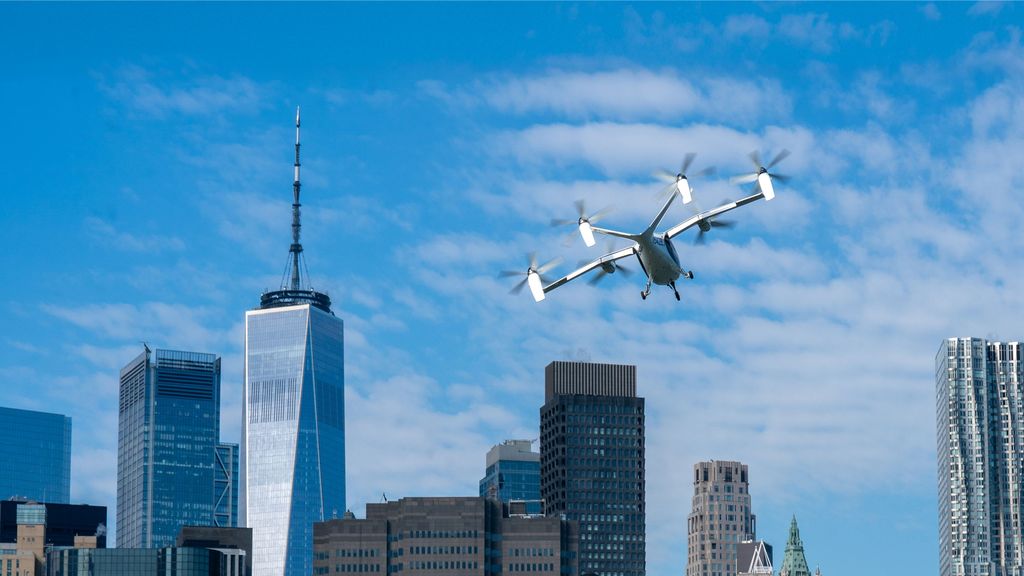
Joby All-Electric Air Taxi
Delta is working with our partners at Joby Aviation to bring to market an all-electric vertical takeoff and landing (eVTOL) air taxi service opens in a new window, enabling a home-to-airport transportation option. As part of the first-of-its-kind arrangement, Delta and Joby are working together to integrate Joby-operated eVTOL service into Delta’s hub airports in New York and Los Angeles, allowing customers to reserve seats for short-range journeys to and from city airports. The Joby aircraft produces zero operating emissions and significantly lower noise than helicopters, barely audible when flying overhead. This service will further elevate and differentiate the Delta travel experience in these strategic markets.
Efficient Aircraft Operations
Enhancing the efficiency of our aircraft operations includes making changes to both operational procedures and aircraft. Much of Delta’s near-term progress has been focused on optimizing fuel efficiency through operational changes and actions taken by the Carbon Council. Additionally, Delta’s Sustainable Skies Lab has begun exploring innovations that enhance our current fleet with new operational technologies.
Exceeded our target of 1% fuel burn savings from operational improvements.
Savings in comparison to fuel consumption in 2019, based on our projected fuel usage had we not undertaken these initiatives and excluding efficiency improvements from fleet renewal.
At a Glance Efficient Aircraft Operations
CARBON COUNCIL
Our drive for efficiency is led by our Carbon Council, a cross-divisional group of senior leaders responsible for driving reductions in fuel consumption in line with our goals.
In 2023, we set a goal to institute operational improvements that save 1% of fuel burn compared to 2019, or 45 million gallons of fuel. In 2025, the operational improvements we put in place over the last few years saved 59 million gallons of jet fuel, worth more than $135 million in annual cost savings. We achieved this milestone by reducing weight on board, introducing technology to track and reduce auxiliary power unit (APU) usage between flights, optimizing aircraft speed and routing, certifying new landing procedures and adding drag reduction technology to our existing fleet, among other initiatives.
In 2025, actions we took to reduce fuel burn included:
- Enhancing operational efficiency at Salt Lake City International Airport (SLC) through design and implementation of adjusted FAA-approved procedures that safely support reduced aircraft separation and more direct arrival paths.
- Reducing catering service weight on transoceanic flights by streamlining the wine selection.
- Reducing fuel weight by equipping additional airports for use as diversion points, reducing contingency fuel weight and associated fuel burn.
We continue to enhance ground procedures and infrastructure to reduce consumption of fuel at the gate, during taxiing and during maintenance.
Our major focus on the ground has been introducing technology to track and reduce APU use between flights. APUs are small engines at the back of the plane that provide power and temperature control while the plane is on the ground. Reducing APU usage can lead to significant fuel savings.
Our efforts to reduce APU runtime include:
- Working with airport partners to increase the installation of ground power units and preconditioned air (PCA) units as an alternative to running APUs at the gate. In 2025, we introduced 15 new PCA units across our network to keep aircraft cool without APU use.
- Installing equipment telematics systems at Hartfield-Jackson Atlanta International Airport (ATL), where we have the greatest concentration of gates, to identify APU usage reduction opportunities. As of 2025 year-end, this equipment was in place at 81% of gates. We also installed indicator lights at 54% of gates to inform pilots that the jet is connected to air and APUs can be turned off.
- Electrifying maintenance pads to replace APU usage with cleaner, quieter electric ground power and air. We electrified our first maintenance pad, in Atlanta, in 2025, which we project will save up to 7 million gallons of fuel annually while enhancing team comfort.
We track progress on our efficiency efforts using key performance indicators (KPIs), such as average APU runtime minutes, service weight per available seat mile and excess endurance fuel carried. We also use these KPIs to engage the 65% of frontline Delta employees who directly impact fuel usage in their roles across airport customer service teams, flight operations and technical operations teams.
Fuel Savings
Fuel Savings During the Year From Operational Improvements Implemented Since 2022
A bar chart titled "Fuel Savings During the Year From Operational Improvements Implemented Since 2022" showing increasing fuel savings in millions of gallons for 2022, 2023, 2024 and 2025.
OPERATIONAL INNOVATIONS VIA THE LAB
Our Sustainable Skies Lab supports operational efficiency by building a pipeline of solutions, working with innovators to develop and test next-generation technology opens in a new window aimed at reducing fuel burn. This effort often takes inspiration from nature and leverages biomimicry, such as Airbus’ fello’fly, rooted in the formation flying technique of geese, and two technologies to reduce drag inspired by fish – riblets for aircraft exteriors from MAKO (formerly MicroTau) and finlets on the back of the fuselage from Vortex Control Technologies. In 2025, Delta dispatchers and pilots took a leading role with Airbus in fello’fly testing opens in a new window, successfully executing rendezvous flights with other participating airlines.
The Sustainable Skies Lab also works with companies that offer ways to reduce fuel consumption during taxiing. For example, the Lab is helping Green Taxi Aerospace develop its electric taxiing system for regional aircraft. Green Taxi’s electric motors can be retrofitted into the main landing gear to power taxiing with the aircraft’s APU, rather than using jet engines.
Delta has also partnered with Georgia Tech to develop digital tools that enable more efficient routing of aircraft – both in the air and on the ground at ATL.
Celebrating Our Sustainability Strategy in Action
Progress on our sustainability strategy requires a full-team effort, and we make sure to recognize our team members who are driving our successes.
In 2025, we launched a new program, Green Station of the Year, to activate airport ground team members in a friendly competition that drives fuel savings through APU runtime reduction. We recognized the below-wing teams at 12 airports, in categories based on size and region, for achieving the largest year-over-year reduction in gate APU usage: LaGuardia Airport (LGA), Miami International Airport (MIA), George Bush Intercontinental Airport (IAH), Ted Stevens Anchorage International Airport (ANC), Kahului Airport (OGG), Fayetteville Regional Airport (FAY), Mexico City Airport (MEX), Haneda Airport (HND), São Paulo/Guarulhos International Airport (GRU), Cibao International Airport (STI), Juan Santamaría International Airport (SJO) and Rafael Núñez International Airport (CTG).
The Sustainable Skies Lab works across every operating business unit at Delta to test and implement new technologies. In 2025, the Lab recognized eight innovators within Delta that were crucial to reaching successful milestones across sustainability initiatives, including our industry-first fello’fly flights, the development of an ATL digital twin that allows us to test more efficient taxi routes, and innovation in our products and recycling processes on board.
In 2025, Delta took part in the fourth annual Aviation Challenge opens in a new window. Organized by the SkyTeam Alliance, this challenge highlights sustainability activities from participating airlines around the world, with the goal of spurring innovation throughout the industry. Delta was awarded “Most Impactful Solution in Maintenance, Repair and Overhaul” for scaling foam-based engine wash technology to replace water washes and improve fuel efficiency. We adopted the new engine wash program in 2024 and continued to expand its use in 2025, achieving strong adoption across key stations. The new wash solution increases engine performance and reduces fuel consumption by using patented foam injection technology developed by AeroCore. Delta was also a co-winner for the “Best Cross-Industry Collaboration” award with Virgin Atlantic and Air France for our fello’fly test flights conducted in 2025.
Cleaner Fuel
One of the most important levers for decarbonizing flight is sustainable aviation fuel (SAF), a liquid hydrocarbon fuel synthetically produced using feedstock derived from renewable sources or waste. While Delta has been successful at increasing SAF usage year on year, the technology has not advanced as rapidly as the industry requires, driving potential risk for decarbonization ambitions across the airline industry.
Most of the challenges around scaling are outside airlines’ control, including policy uncertainty, price premiums, the high cost of capital and logistical constraints, all of which contribute to ongoing limited supply.
Despite the current challenges for SAF, Delta is committed to being a key player in the growth of the SAF industry. We strive to deliver progress in the areas we can influence and where we have a direct ability to support scaling – by engaging across the development value chain, signing offtake agreements with SAF producers and advocating for government policies to address SAF affordability and support financing and development of greater production capacity.
Increased SAF procurement by 80% compared to 2024.
Expanded our SAF delivery network to over 30 airports globally.
At a Glance Cleaner Fuel
OUR TARGETS
2030: 10% SAF usage
2035: 35% SAF usage
2050: 95% SAF usage
OUR PROGRESS
- Increased SAF usage by 80% compared to 2024, for a total of 23.4 million gallons,5 avoiding 205,000 metric tons CO2e of GHG emissions in 2025.
- Received SAF at over 30 airports globally.
Annual SAF Procurement5
A bar chart titled "Annual SAF Procurement" showing the amount of Sustainable Aviation Fuel (SAF) Delta procured from 2020 to 2025, measured in millions of gallons.
SAF PROCUREMENT
Delta continues to increase SAF usage, securing 23.4 million gallons5 in 2025, an increase of 80% from 2024, for a total of 42 million gallons used since 2021.
Long-term SAF procurement has been a challenge for all airlines, and we recognize the current state of development means we will not receive all gallons we contract for. To address this supply risk, our procurement strategy focuses on maintaining a diverse portfolio of SAF technologies and suppliers, with continuous producer engagement and ongoing evaluation for offtake opportunities.
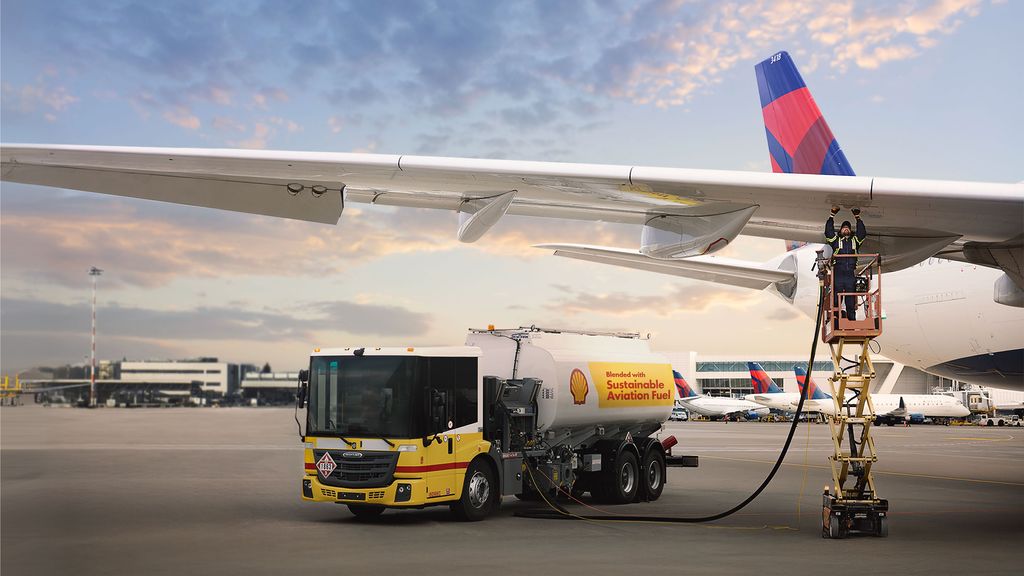
In 2025, we collaborated with industry-leading suppliers such as Shell Aviation, Montana Renewables, Neste, Valero and others to source SAF across voluntary and mandated markets, enabling continued growth despite limited global supply. We have also entered into new offtake agreements with many of these suppliers for 2026 and beyond. Our experience has shown that collaborating with proven suppliers that leverage existing capabilities and established supply networks is critical to scaling SAF.
We are also expanding how and where we receive SAF. In 2025, we received SAF at over 30 airports globally, including the first-ever commercial-scale SAF delivery at Portland International Airport (PDX), in collaboration with Shell Aviation, Montana Renewables and the airport. In addition, we expanded our supply portfolio to include both physical SAF deliveries and purchases of SAF certificates (a process also known as “book and claim,” where the emissions reduction attributes are decoupled from the physical fuel). This flexibility in how we receive SAF enables our efforts to increase procurement across voluntary and mandated markets worldwide.
Beyond supply availability, the high cost of SAF relative to conventional jet fuel remains a challenge. To help mitigate some of the SAF premium, Delta provides a range of corporate and cargo customer offerings to support mutual decarbonization efforts, as well as consumer-facing programs. To date, these programs have been central to enabling growth and will play a key role in our strategy until SAF prices achieve parity with conventional fuels. At the same time, achieving affordability relative to conventional jet fuel is critical for SAF to meaningfully scale and become widely adopted.
SCALING SAF PRODUCTION AND DEVELOPMENT
Delta continues to support and expand important partnerships and coalitions across industries to help scale the SAF market.
We remain a committed anchor partner in the Minnesota SAF Hub, a first-of-its-kind coalition that leverages collaboration across the value chain to scale SAF at Minneapolis–St. Paul International Airport (MSP) while supporting economic development in Minnesota. The next major milestone for the Minnesota SAF Hub is activating ratable SAF supply at MSP in 2026, through a blending facility currently under development in collaboration with the Hub and Flint Hills Resources.
We are committed to capitalizing on the momentum generated through our coalition efforts and will continue to leverage cross-industry collaboration to support investor confidence and advance SAF technologies.
Finally, legislative support is essential for scaling SAF production. As part of our commitment to transparent climate policy leadership, we engage in state, federal and international SAF policy advocacy to support initiatives that will help accelerate SAF development and affordability. For more information on this work, please see our Climate Lobbying update.
Ground Operations and Facilities
Adopting sustainable practices at our facilities, including terminals, maintenance hangars and corporate offices, helps further reduce our environmental impacts.
Began installation of rooftop solar panels across our Atlanta campus with Cherry Street Energy, capable of covering up to 60% of campus electricity demand during peak solar hours once the project is fully completed.
Peak solar hours defined as the equivalent 4–6 hours per day when solar irradiance is highest.
At a Glance Ground Operations and Facilities
2025: 50% GSE electrification and five hubs at 100% of core fleet6
2035: 100% of hubs’ core GSE electrified6,7
2050: 100% net-zero operations
OUR PROGRESS
- Purchased and deployed 2,576 electric GSE units since 2020, achieving 42% electrification of core GSE fleet.6
- Began installation of rooftop solar panels across our Atlanta campus with Cherry Street Energy, capable of covering up to 60% of campus electricity demand during peak solar hours once the project is fully completed.8
GROUND SUPPORT EQUIPMENT
Ground support equipment (GSE) such as tow tractors and belt loaders traditionally rely on diesel and other fossil fuels, contributing to GHGs and other emissions. Replacing fossil fuel-powered GSE with electric GSE (eGSE) helps reduce fuel consumption and GHG emissions, improves air quality, lowers noise levels and unlocks significant operational efficiencies for Delta’s ground services teams, including reduced maintenance, lower operating costs and enhanced safety performance. As of 2025, we have electrified 42% of our core GSE fleet.6
Delta continually evaluates our sustainability strategy and prioritizes investments in areas that deliver the greatest reduction in emissions per dollar spent. In 2023, we set targets to electrify 50% of GSE by 2025 and 100% of hubs’ GSE by 2035. As we pursued this work, it became clear that the carbon impacts vary greatly, depending on factors like utilization rates of the units, engine emission rates, advances in emission technology and the fuel mix used. Consequently, we are refocusing our GSE electrification efforts on our core fleet (our most utilized units) and revising our 2035 goal, targeting electrification of 100% of core GSE fleet at our hubs. We are simultaneously shifting near-term investments to accelerate emissions reductions in aircraft fuel consumption, as these initiatives offer more impactful ways to reduce carbon emissions.
We also continue to replace older gas and diesel units with new engines with strict emission controls and expand use of renewable diesel. Using cleaner fuels in existing assets allows for immediate emissions reductions at a lower cost.
CAMPUS GREENING
We also seek to minimize the environmental impacts of our corporate facilities. Delta’s 1940s headquarters are the oldest surviving buildings of the Atlanta airport and were designated a Historic Aerospace Site in 2011. Rooftop solar installed at our General Office headquarters produced 606 megawatt-hours of electricity over the course of six months in 2025 and reduced associated electricity costs for Delta.
ENERGY CONSUMPTION IN OUR FACILITIES
We continue to build upon our commitment to reduce energy-related GHG emissions across all ground operations and facilities, including both owned and leased properties, in collaboration with our airport, city and other local partners.
Delta’s Facility Electricity Mix9
A pie chart titled “Delta’s Facility Electricity Mix” shows 45% natural gas, 20% coal, 19% nuclear, 4% hydropower, 4% biomass, 2% solar, and 1% wind. A footnote to the chart reads “Delta’s grid mix is calculated by aggregating a national fuel profile provided by the U.S. Environmental Protection Agency’s Emissions & Generation Resource Integrated Database with Delta’s energy consumption across different geographies.”
The Travel Experience
The majority of solid waste from our operations comes from the travel experience, including onboard services, catering and Delta Sky Clubs.
Our long-term ambition is to send no waste associated with the customer travel experience to landfill by 2050. In the near term, we are working to reduce single-use plastics from our cabins and divert more waste from landfill, while improving the overall customer experience.
Fully rolled out newly designed paper cups across our global operations, replacing single-use plastic cups in our onboard services.
At a Glance The Travel Experience
REDUCING SINGLE-USE PLASTICS
We set a target for ourselves of minimizing single-use plastics on board by 2025. Since then, we have replaced plastic cutlery and dishware12 with plant-based alternatives, replaced plastic packaging for earbuds with kraft paper and replaced plastic cups with paper cups.
Historically, single-use plastic cups have been one of our most significant waste streams. After several years of testing and a full-scale life-cycle analysis, we introduced a new paper cup in 2024 and fully rolled it out across our global operations in 2025. Our new paper cup meets Delta’s high standards for performance and stringent regulations across multiple international jurisdictions.
Our cups need to: keep hot drinks hot, keep cold drinks cold, hold up to the dissolving properties of alcohol, easily separate with one hand, fit efficiently in galley cart drawers and avoid polyethylene liners that make traditional paper cups difficult to recycle or compost. With expert partners and engaged flight crews, catering and operations teams, we designed a cup that meet these demands, with additional benefits for efficiency: The new design replaces two different types of cups, helping to save space on board and streamline stocking procedures. In addition, the cups can be composted or recycled where airport facilities are in place. We estimate the new cup will avoid seven million pounds of plastic annually.11

ENHANCING RECYCLING AND LANDFILL DIVERSION
One of the primary challenges to increasing landfill diversion is the availability and consistency of recycling infrastructure at airports.
To address this challenge, our efforts to divert waste from landfill center on recycling and composting programs in our catering kitchens co-located at airports where recycling infrastructure is available. In 2025, we added composting to a fourth catering kitchen, at Boston Logan International Airport (BOS).
Beginning in 2026, we are piloting a refreshed onboard recycling process designed to reduce reliance on airport‑based systems. Under this new approach, recyclable materials collected on board will be returned to catering kitchens where established recycling infrastructure already exists. We also anticipate launching an international recycling pilot on select inbound international routes in fall 2026.
Supply Chain
Advancing ethical and responsible procurement practices supports our aim of creating a world-class supply chain and helps deliver on our climate goals. Our current focus is on better understanding the environmental performance of our suppliers.
Delta has developed a proprietary carbon tracking system to enable our supply chain organization to calculate and track supplier carbon emissions. In 2025, we loaded all our suppliers into the new system, surpassing our target of onboarding all preferred vendors. In early 2026, we began to enhance the system by incorporating supplier-specific emissions-based reporting, supplementing with spend-based reporting when supplier information is not available.
We continue to encourage our suppliers to complete the EcoVadis sustainability assessment, to help us understand supplier performance and to recognize positive practices that support our goals. As of 2025, 1,051 Delta suppliers, representing 61% of our supplier spending, were onboarded to the EcoVadis platform, up from 710 in 2024.