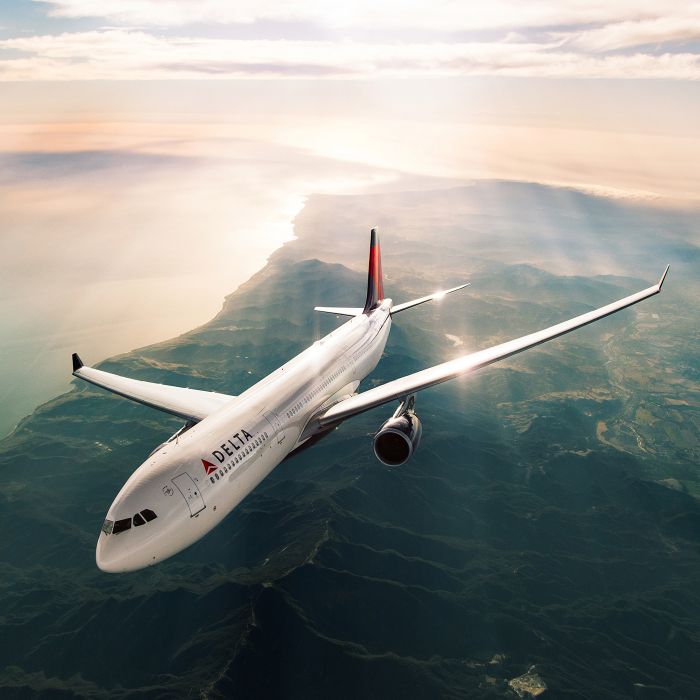

A Delta airplane viewed from above flies under a hazy sky above a rugged coastline and mountainous landscape. Sunlight reflects off the aircraft’s wings.

Delta’s Sustainability Strategy

We believe that addressing the climate impact of aviation is essential to preserving the vital role that air travel plays in global connectivity and commerce. That is why we continue to focus on decarbonizing our airline operations, with the aspiration of achieving net-zero carbon emissions by 2050.

With around 90% of our greenhouse gas (GHG) emissions coming from jet fuel, achieving net-zero emissions by 2050 depends on our ability to successfully decarbonize our flight operations. Our sustainability strategy supports our net-zero aspiration by focusing on:

  • What We Fly: evolving our fleet through continued investment in next-generation aircraft while partnering to develop revolutionary fleet technology
  • How We Fly: adopting new technologies, procedures and other strategies to improve fuel efficiency
  • The Fuel We Use: collaborating to scale supply and reduce the cost of sustainable aviation fuel (SAF)

We are also working to integrate electric power and cleaner fuels into our ground support equipment (GSE) and incorporate more sustainable products and practices in the travel experience and our supply chain.

Progress will be shaped both by our own actions and by factors beyond our direct control, including customer demand, technological innovation, government policy and incentives, and the activities and investments of others in our industry and value chain. We remain committed to ongoing collaboration with our industry partners, policymakers and stakeholders and to monitoring and adapting our strategy as conditions change.

We are in the process of recalibrating our net-zero glide path opens in a new window to better reflect progress to date and future projections. We anticipate providing an update to our 2050 pathway in our 2026 Delta Difference Report.

WHAT WE FLY Improving fleet-wide fuel efficiency through ongoing renewal and working to reimagine What We Fly in a net-zero world FLEET EVOLUTION WHAT WE FLY HOW WE FLY Continually improving What and How We Fly to maximize the efficiency of our existing fleet and operations EFFICIENT AIRCRAFT OPERATIONS HOW WE FLY Reducing waste and delivering more sustainable products and amenities to our customers THE TRAVEL EXPERIENCE HOW WE FLY THE FUEL WE USE Reducing impacts of GSE, 
facilities and other operations GROUND OPERATIONS AND FACILITIES THE FUEL WE USE Addressing barriers to increase the availability and affordability of SAF CLEANER FUEL ¹ WHAT WE FLY HOW WE FLY THE FUEL WE USE Understanding and reducing climate impacts associated with the goods and services we purchase to run our business SUPPLY CHAIN

An image divided into three sections outlining Delta's long-term strategy focused on "What We Fly," "How We Fly," and "The Fuel We Use."

Our Sustainability Targets

Delta is pursuing a range of near-, medium- and long-term targets in support of our sustainability strategy and to realize our net-zero ambitions. We discuss progress on these goals in the sections that follow. A summary of our goals and near-term progress is in the table below.

Milestone
Near-term
Near-term Progress
Mid-term
Long-term
Near-term
2025 10+%

fuel-efficiency gains2

2025 5

partnerships with revolutionary tech players

Near-term Progress
ONGOING 6.4%

fleet-wide fuel efficiency gain2

ACHIEVED 5

partnerships signed

Mid-term
2035 20+%

fuel-efficiency gains2

2035 1st

operation of mainline revolutionary technology

Long-term
2050 40+%

fuel-efficiency gains2

2050 25% revolutionary aircraft in fleet

Efficient Aircraft Operations

Read more on Efficient Aircraft Operations
Near-term
2025 1%

fuel burn savings from operational improvements (45M gallons)3

Near-term Progress
ACHIEVED 59M

gallons of jet fuel – and over $135 million – saved from operational improvements3

Mid-term
2035 3%

operational fuel savings3

Long-term
2050 5%

operational fuel savings3

Near-term
2030 10%

SAF usage

Near-term Progress
ONGOING 23.4M

gallons of SAF used,4 an 80% increase from 2024

Mid-term
2035 35%

SAF usage

Long-term
2050 95%

SAF usage

Ground Operations and Facilities

Read more on Ground Operations and Facilities
Near-term
2025 50%

GSE electrification

2025 5

5 hubs at 100% of core fleet5

Near-term Progress
ONGOING 42%

electrification of core GSE fleet, with 2,576 electric GSE units deployed since 2020

Mid-term
2035 100%

of hubs’ core GSE electrified5,6

Long-term
2050 100% net-zero operations
Near-term
2025 Minimize

single-use plastics on board

Near-term Progress
ACHIEVED Fully replaced

disposable cups, cutlery, dishware7 and earbud packaging with plant-based or paper-based alternatives

Mid-term
2035 65%

waste diversion from landfill8

Long-term
2050 100%

waste diversion from landfill8

Near-term
2025 100%

of preferred vendors9 on a carbon tracking system

Near-term Progress
ACHIEVED 100%

of vendors in our carbon tracking system

Mid-term
2030 100%

of preferred vendors9 with net-zero plans

Long-term
2050 100%

net-zero supply chain

  1. SAF is not emissions-free, but it has lower life-cycle GHG emissions as compared to conventional jet fuel because it is made with renewable feedstocks.
  2. Compared to 2019.(a) (b) (c) (d)
  3. Compared to 2019 and relative to what would have been used had these initiatives not been undertaken, and excluding efficiency improvements associated with fleet renewal.(a) (b) (c) (d)
  4. SAF volume is measured and reported neat, before blending. In 2025, SAF accounted for less than 1% of Delta’s total fuel usage.(a)
  5. Core GSE fleet consists of baggage tractors, belt loaders and aircraft tow tractors.(a) (b)
  6. Delta updated this target in 2025. The previous target was 100% of hubs’ GSE electrified and renewable energy powering operations by 2035.(a)
  7. Disposable hot item dishware currently requires a plastic lining to prevent leakage.(a)
  8. As it relates to customer onboard travel experience, excluding other aspects of aircraft operations.(a) (b)
  9. Preferred vendors are vendors that are also Delta corporate sales partners and calculate their emissions per the GHG Protocol.(a) (b)