
Employee Safety Programs and Training
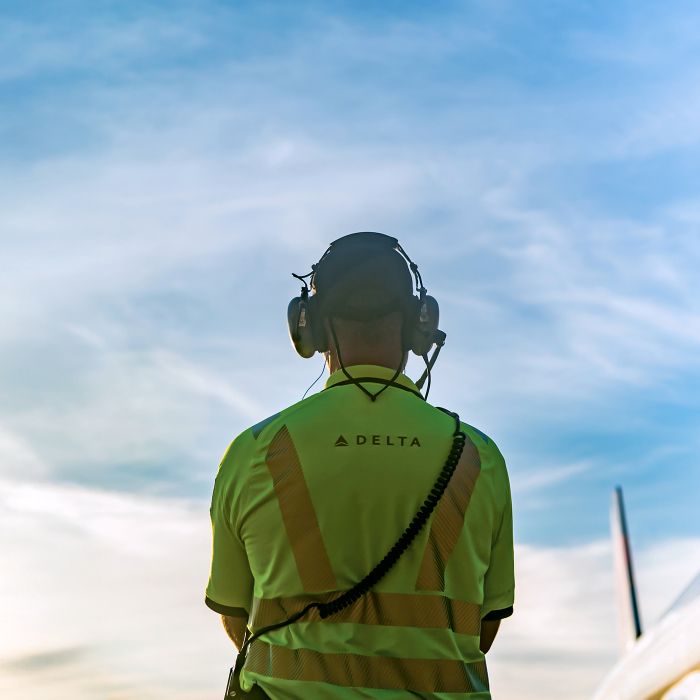
Delta is committed to ensuring that all our employees and partners have a safe work environment. By heavily investing in tools and technology across our airline and initiatives to enhance our safety culture, we work to prevent safety-related incidents, including employee injuries and illnesses. We focus on providing the policies, procedures and education that are essential to keeping our people and customers safe.
DART and TRIR are standard industry safety metrics used to measure workplace injury rates and the frequency of more severe injuries that result in job restrictions or time away from work. Monitoring these measures enables us to identify trends and assess performance over time, reinforcing proactive actions that help reduce injuries and promote a strong safety culture.
Safety Culture
Delta’s Code of Ethics and Business Conduct: The Way We Fly opens in a new window reinforces our safety expectations and standards for employees and business partners around the world. We are committed to empowering employees and partners to report hazards and mistakes, to responding in a fair manner, and to prioritizing continuous improvement and learning from incidents.
Our safety reporting programs are a cornerstone of Delta’s safety culture and SMS. These programs ensure all employees have an easy and effective way to share safety concerns and inadvertent deviations from policies and procedures. We maintain voluntary hazard reporting programs for all frontline employees that encourage the confidential disclosure of any potential incidents that may affect our overall safety performance. In 2025, nearly 90,000 frontline employees – including pilots, flight attendants, dispatchers, load planners, schedulers, ground agents, maintenance personnel and engineers – had direct access to voluntary hazard reporting. Delta is committed to a culture where employees may freely share safety concerns and inadvertent deviation from policies and procedures without fear of retaliation.
We understand that people sometimes make mistakes while trying to do the right thing. Our safety culture focuses on implementing lessons learned rather than placing blame on individuals. In 2025, Delta employees reported 128,511 safety concerns internally, helping us to continue proactively managing risk.
As part of our safety culture, we empower our employees and business partners to slow down or stop any operation if they feel it is necessary to do so for safety reasons. This includes promoting the use of Safety Time Outs, which are employee-initiated pauses to address safety concerns. Empowering employees in this way helps us to maintain a safe working environment for our colleagues and a safe travel experience for our customers.
As a result, we enable a safe working environment across the company and work to maintain and continually improve our overall safety performance year over year, including a 3% reduction in total recordable injuries since 2024.
Refreshed and expanded access to our company-wide Safety Management System course to all Delta employees and specific contract employees.
3.32
DART in 2025
(Days Away, Restricted or Transferred)
4.02
TRIR in 2025
(Total Recordable Incident Rate)
Safety Training and Initiatives
Delta provides employees with comprehensive safety training, which covers subjects such as regulatory compliance, workplace hazards, safety behaviors and personal protective equipment. To supplement training and embed a culture of safety throughout Delta, we regularly communicate the importance of safety through weekly videos, internal posts, town halls and daily interactions with leaders and within workspaces.
In 2025, we refreshed and expanded access to our company-wide SMS course to all Delta employees and specific contract employees, to support awareness and understanding across the company and bolster the division-specific trainings already underway. The new course also includes an assessment to help us better gauge the overall SMS competency of our employee base.
A cornerstone of our safety program is our annual Safety & Environmental Summit, where nearly 500 of our safety and operations leaders and professionals, including our Chief Operating Officer and other members of our senior leadership team, gathered to discuss safety and environmental best practices in 2025. Seminars and workshops at the summit focus on subjects such as safety culture and improvements, investigation techniques, regulatory compliance, environmental risk management, proper handling of dangerous goods, spill prevention, occupational injury prevention and aircraft damage prevention.
Combating Human Trafficking
Recognizing the reality of human trafficking in aviation, we are committed to stand against human trafficking by equipping our employees to help protect the travelers most at risk.
In 2011, we became the first airline to sign the Code of Conduct outlined by the organization End Child Prostitution, Child Pornography and Trafficking of Children for Sexual Purposes. We became a founding member of the Global Business Coalition Against Human Trafficking the following year.
Since then, Delta has required our customer-facing employees to complete training to identify and report human trafficking.
Delta is also a member of Transportation Leaders Against Human Trafficking, a U.S. Department of Transportation initiative designed to maximize the transportation industry’s collective impact on ending human trafficking. We partner with Freedom United to educate travelers on human trafficking indicators. We also support the National Human Trafficking Hotline, which connects victims with services to get help.
In 2025, Delta was again the title sponsor of the Wellspring Living Courage Gala, funding critical programming for survivors of and those at risk of human trafficking.

At Delta, we believe that every person deserves a life filled with dignity, hope and the freedom to thrive.”