Safety Management System
Delta’s SMS is our holistic approach to ensuring both occupational and operational safety throughout the company. Through safety management protocols, the SMS prioritizes hazard identification, risk assessment and mitigation, safety performance monitoring and the promotion of a company-wide safety culture.
Safety Leadership is an essential element of our SMS and key to our success. Safety Leadership comprises a set of behaviors demonstrated by individual actions that drive our overall safety culture and are promoted company-wide. These include integrity, clear communication, accountability, listening and care. With each and every employee embracing these shared principles, we continue to illustrate our commitment to the safety of our people and customers and to making safety our No. 1 value.
Invested $25 million in air conditioning units, auxiliary power units and related services, technology and equipment at stations with the highest risk of hot cabins.
Delta's Safety Leadership Circle showing "Safety Culture" at the center, surrounded by "Policy," "Risk Management," "Assurance," and "Promotion".
Proactive Safety Management
As part of our SMS, Delta uses Safety Risk Management (SRM), a process through which we proactively identify potential safety hazards and put into place controls to mitigate risk. At Delta, we consider SRM an essential element of change management, and it is routinely applied as changes occur around the airline, including:
- Implementation of new systems, such as a new aircraft type
- Revision of existing systems, such as procedural or manual changes
- Development of new procedures, such as adding new airports to our network
- Identification of new hazards or ineffective risk controls through proactive analysis of our safety data
Delta continues to explore and leverage new technology to enhance safety management. For example, in 2025, Delta safety teams continued to integrate artificial intelligence (AI) to analyze operational safety reports. With AI, the pilot safety reporting team has reduced report-processing time significantly, enabling the team to reallocate its time to analyzing reports and identifying safety trends. In addition, by using AI to more consistently code safety taxonomy, the teams are better able to leverage data from safety reports in their risk management discussions. The AI tool’s speed and accuracy reduce the amount of time our experts spend on administrative tasks, allowing more time to consider both the trending risks in our complex air travel industry and the mitigations needed to address those risks. Importantly, even with this application of AI, a human is always present in the safety system to ensure the quality of reporting and analysis. Moving forward, the safety teams will train and evolve the AI capability to assist with how we analyze risk within and across operational divisions.
Safety Technology
As part of our commitment to proactive safety management, we are sharing and communicating performance data with pilots as it relates to safety, so they can make adjustments in real time. This includes continuing to expand the use of FlightPulse, a strategic impact app that transforms raw flight data into clear, actionable insights. FlightPulse enables pilots to analyze data associated with their flight plans to assess how they compare against standard operating practices, as well as other peers in a nonpunitive environment. FlightPulse can also be used in flight to observe any relevant top risks at any given location – including weather, historical trend data and regulatory considerations – and make necessary adjustments midflight.
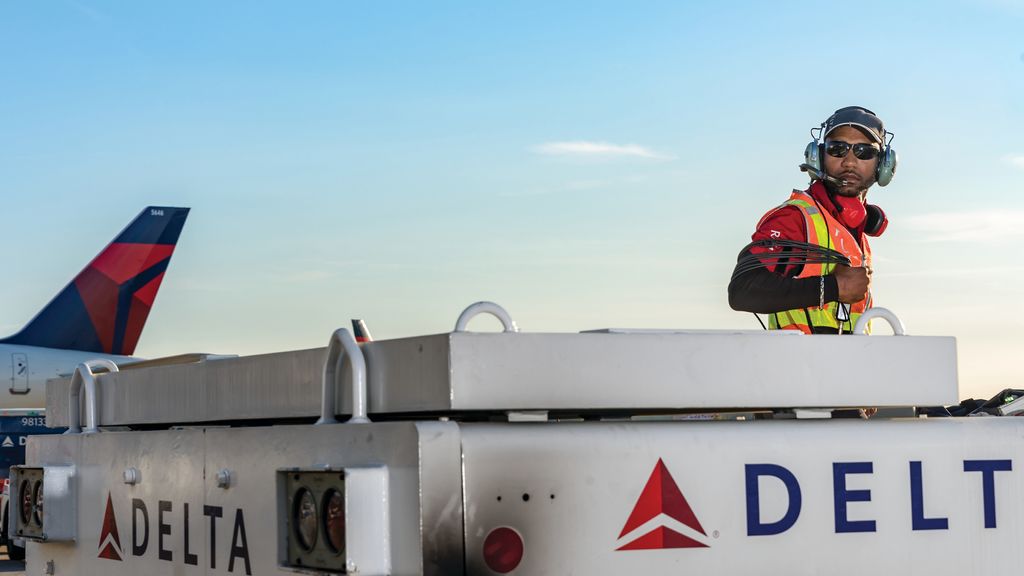
In 2025, Delta continued to make major investments in safety-related infrastructure as well as safety equipment upgrades, such as collision avoidance systems for ground support vehicles, power stows for efficient aircraft loading and air-conditioning units to keep aircraft cool for Delta ground teams.
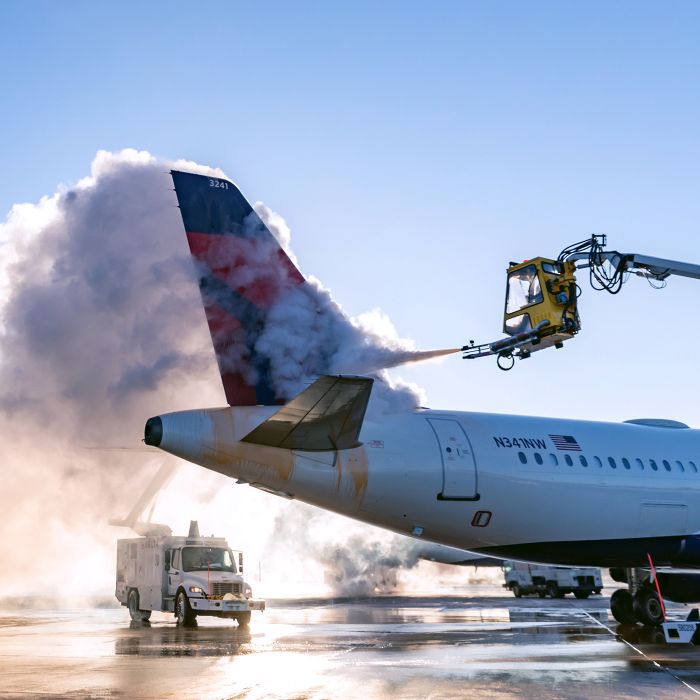
Aircraft Deicing
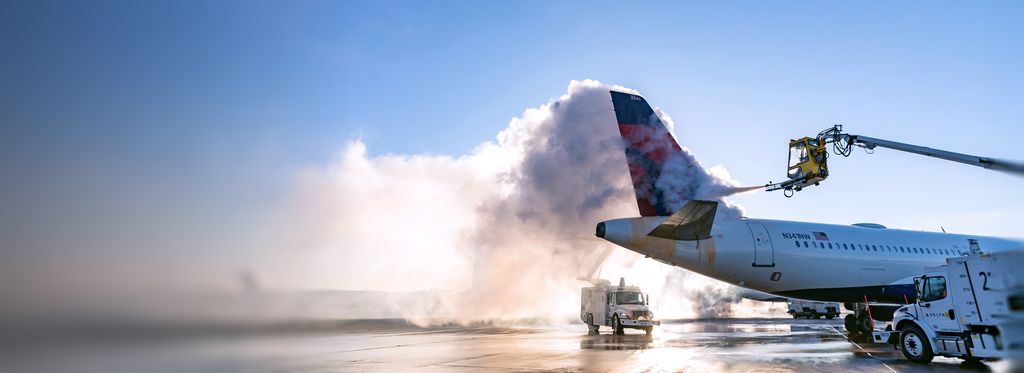
We also continue to enhance management of the key seasonal risk area of aircraft deicing. Prior to the upcoming season, we proactively review lessons learned from the previous season, update procedures and reinforce key concepts through training, including modern virtual reality training. Furthermore, we leverage robust assurance through employee reporting, routine audits during storms and continual proficiency checks of our deicing teams throughout the season. The data from these sources allows us to take a risk-based approach when analyzing performance and addressing issues. All of these items ensure we proactively manage risk to provide safe operations.
In 2025, Delta began integrating our flight crew deice checklists into the same iPad application that flight crews use to compute their anti-ice holdover time, thereby simplifying the process for them.
Safety Assessments and Audits
Through Delta’s Internal Evaluation Program, we routinely conduct assessments to evaluate the effectiveness of key operational programs across the airline and their compliance with Delta protocols. Process assessments such as these play a critical role in ensuring the health and effectiveness of our safety policies and procedures. We also conduct regular quality assurance audits across domestic and international locations, to monitor all Delta ground and maintenance operations. All audit results are transferred into Delta’s overarching SMS and made available for review by senior leadership on a monthly basis. In 2025, Delta moved to continuous (rather than “snapshot”) assessments through the global Line Operations Safety Audits (LOSA) program, enabling us to better mitigate risk.
To complement our internal safety assessments and audits, Delta also receives independent, third-party safety audits carried out by the Federal Aviation Administration (FAA), the International Air Transport Association’s (IATA’s) Operational Safety Audit (IOSA) Program and the U.S. Department of Defense. In 2024, Delta successfully completed the revised Risk-Based IOSA, a biennial audit focused on key standards across operating divisions and demonstrating our high performance and dedication to safety. Our next IOSA is scheduled for 2026.
Safety Programs and Industry Groups in Which Delta Serves as an Active Participant, Leader or Member
- Airlines for America (A4A) – Safety Council and committees
- American Society of Safety Professionals (ASSP)
- Aviation Safety Action Program (ASAP) – confidential employee safety reporting
- Aviation Safety Team (AST)
- Commercial Aviation Safety Team (CAST)
- Aviation Safety Information Analysis and Sharing (ASIAS) system
- Flight Operational Quality Assurance (FOQA) Program – flight data monitoring
- Flight Safety Foundation (FSF)
- Ground Handling Operations – Safety Team (GHOST)
- International Air Transport Association (IATA) – Safety Group and committees
- International Society of Air Safety Investigators (ISASI)
- Line Operations Safety Audits (LOSA)
- National Safety Council (NSC)
Addressing Risks Related to High Temperatures
Delta’s work environments at airport facilities and in aircraft cabins are seasonally subject to high temperatures at some of the airports we serve, particularly in the South and southwestern parts of the U.S.
Our SMS provides the framework to proactively manage risks related to high temperatures. We use data from the Occupational Safety and Health Administration (OSHA) recordable injuries reporting, employee safety reports, equipment reliability reports and customer experience reports to provide an understanding of our risk profile related to heat-related issues. These risks are continually analyzed and discussed on a weekly, monthly and quarterly basis by our safety and operations teams and ultimately reviewed by our SMS Accountable Executive(s) with the Safety and Security Committee of our Board of Directors. In addition, heat-related risks occurring at airport locations where Delta utilizes third-party contractors are reviewed monthly and quarterly to ensure safety risks are regularly discussed and addressed with those providers. In 2025, Delta had zero recordable heat-related injuries or illnesses.
AIRPORT RAMP ENVIRONMENT
We maintain Heat Injury/Illness Prevention Plans locally to minimize heat risk in our ground operations (or “ramp”) environment. These plans are maintained by Delta and our contractors, and all plans must include the following elements:
- Access to water
- Access to shade
- Emergency procedures
- Training on the plan for all employees
Additional procedures may include safety alerts, leadership check-ins with employees and working with a buddy to watch over each other during periods of high temperatures. The plans are updated annually by local and corporate leaders and checked by safety compliance auditors no less than once every 24 months. While we make our best effort to execute a strong, comprehensive plan, we also recognize that the policies and procedures may not cover all situations in our dynamic environment. Therefore, our culture is one of empowerment, where any employee or contractor may call a Safety Time Out to pause to correct a safety issue, including heat-related issues, with the assurance that they will be fully supported by senior leaders. Furthermore, we are proud to partner with the Korey Stringer Institute, guiding Delta in our efforts to proactively address the risk of heat-related injuries/illnesses, which includes improved policies and procedures, new training and heat safety visits across the Delta system.
AIRCRAFT CABINS
High temperatures, maintenance challenges or other factors sometimes lead to elevated temperatures in airplane cabins, especially during ground operations. In extreme cases, passengers, flight and cabin crew, and ground team members servicing aircraft can experience conditions that present personal safety and health risks. We are upgrading air-conditioning units across the system, and we have developed proactive weather alerting that identifies airports and flights with increased risk of a hot-cabin incident. These alerts allow for timely preparation – not only of our equipment to support customers on board, but also for our employees and our contractors, who are exposed to the effects of higher outside air temperatures, to have the necessary means to avoid or manage hot-cabin events. In 2025, Delta invested $25 million in air-conditioning units, auxiliary power units and related services, technology and equipment at stations with the highest risk of hot cabins. Looking forward, we plan to continue investing to reduce the overall age of equipment.